

Pichwai: Where Art Becomes Darshan The Living Soul of Nathdwara
Step into the enchanting world of Pichwai, where art becomes darshan. Discover the living soul of Nathdwara through Shrinathji, sacred festivals, blooming lotus gardens, graceful cows and peacocks, and the timeless beauty of authentic handmade Pichwai art.
Hi,
There are paintings we look at.
There are paintings we admire.
And then there are paintings that seem to look back at us.
Pichwai belongs to the third kind.
Born from the devotional culture of Nathdwara in Rajasthan, India, Pichwai is far more than a painting on cloth. It is a visual language of devotion, celebration, nature, poetry and divine presence.
For centuries, these richly detailed paintings have accompanied the worship of Shrinathji — the beloved form of Krishna associated with Nathdwara. Traditionally, Pichhwais were placed behind the principal image in a shrine, transforming the space around the deity according to the season, festival and devotional occasion.
But to understand Pichwai merely as a “traditional Indian painting” is to see only its surface.
To understand Pichwai is to discover a world where art becomes atmosphere, colour becomes devotion, and painting becomes a doorway to darshan.
A Painting That Was Never Meant to Stand Alone
The word Pichhwai is commonly associated with the idea of something placed “behind” the principal deity.
And this simple idea contains a profound artistic philosophy.
A Pichwai was not originally created simply to decorate a wall.
It was created to create a world around the divine image.
Imagine entering a shrine.
Before you is Shrinathji.
Behind Him is a vast painted universe.
Lotus flowers bloom.
Cows gather peacefully.
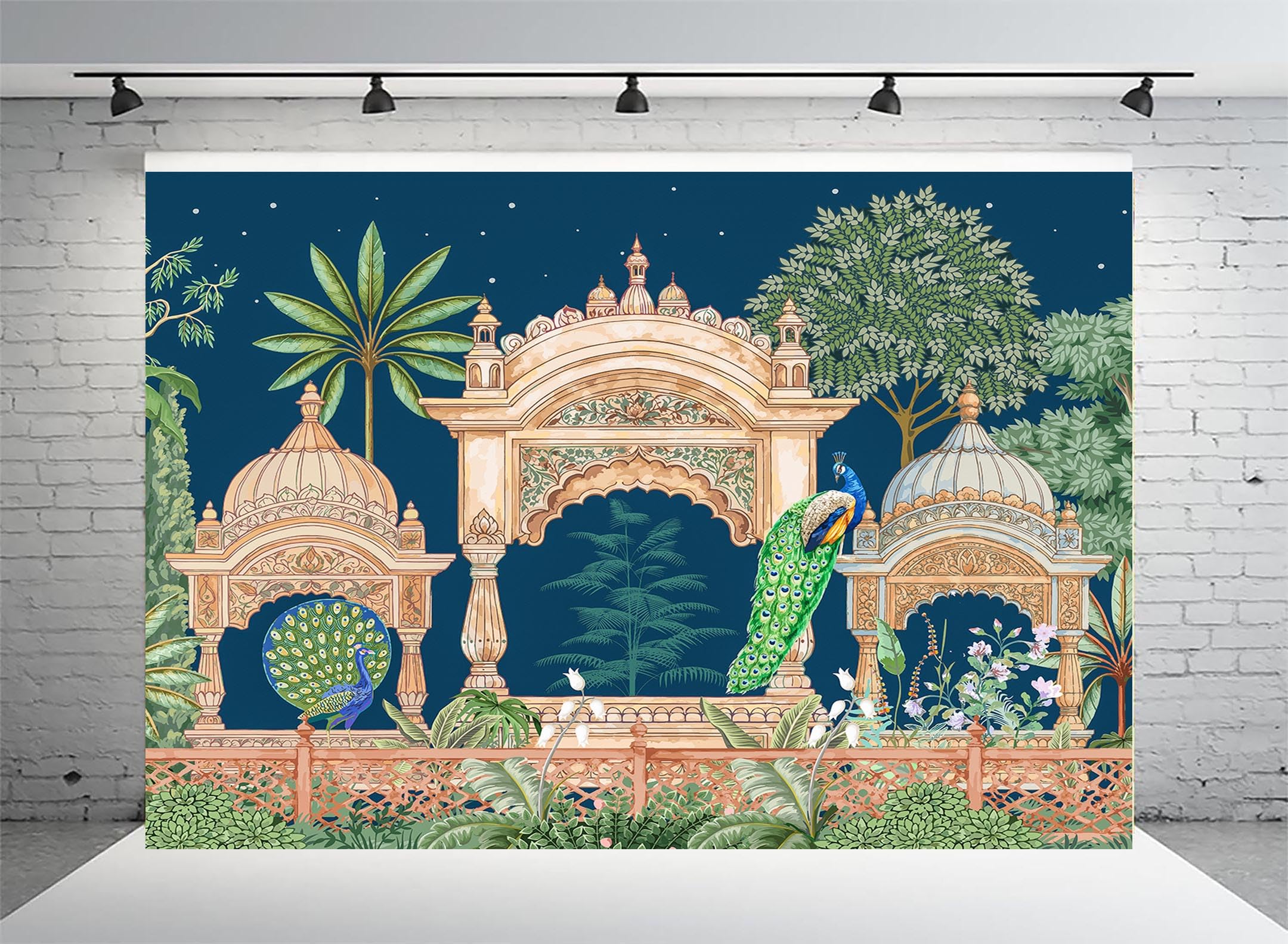
Peacocks dance among foliage.
Trees rise into intricate patterns.
Gopis appear in graceful devotion.
The moon shines over Sharad Purnima.
Festivals come alive through colour, ornament and movement.
The painting does not merely illustrate devotion.
It creates the environment in which devotion can be experienced.
This is one reason Pichwai remains so extraordinary.
Nathdwara: The Sacred Home of Shrinathji
To understand Pichwai, one must first understand Nathdwara.
Nathdwara is a sacred town in Rajasthan, situated near Udaipur and associated with the worship of Shrinathji, a form of Krishna shown with His left arm raised as He lifts Govardhan Hill. The town's name itself is derived from Nath — Lord — and Dwar — gateway.
The story of Shrinathji is deeply connected with the devotional history of Krishna worship.
According to the traditional account recorded in museum scholarship, the sacred image associated with Shrinathji was moved from the Mathura region in the seventeenth century and eventually became established at Nathdwara. The image became the centre of a powerful devotional tradition, around which the Pichhwai painting tradition flourished.
From that moment, painting and worship became beautifully intertwined.
When the Seasons Enter the Shrine
One of the most beautiful things about Pichwai is that it does not treat time as something separate from art.
The year itself becomes part of the painting.
Different festivals, seasons and devotional occasions inspire different Pichwai compositions.
A summer Pichwai can feel cool and refreshing.
A monsoon composition can fill the imagination with clouds, rain and greenery.
A Sharad Purnima Pichwai can transform the shrine into a luminous moonlit world.
A Pichwai celebrating the cows can fill the composition with peaceful herds, calves, flowers and the abundance of nature.
Historical Pichhwais preserved in international museum collections demonstrate how specific festival occasions influenced their imagery. The Metropolitan Museum, for example, holds a Pichhwai associated with Gopashtami, the festival celebrating Krishna's role as a cowherd.
This is why Pichwai can never be reduced to one fixed design.
Pichwai changes with the sacred calendar.
Shrinathji: The Heart at the Centre
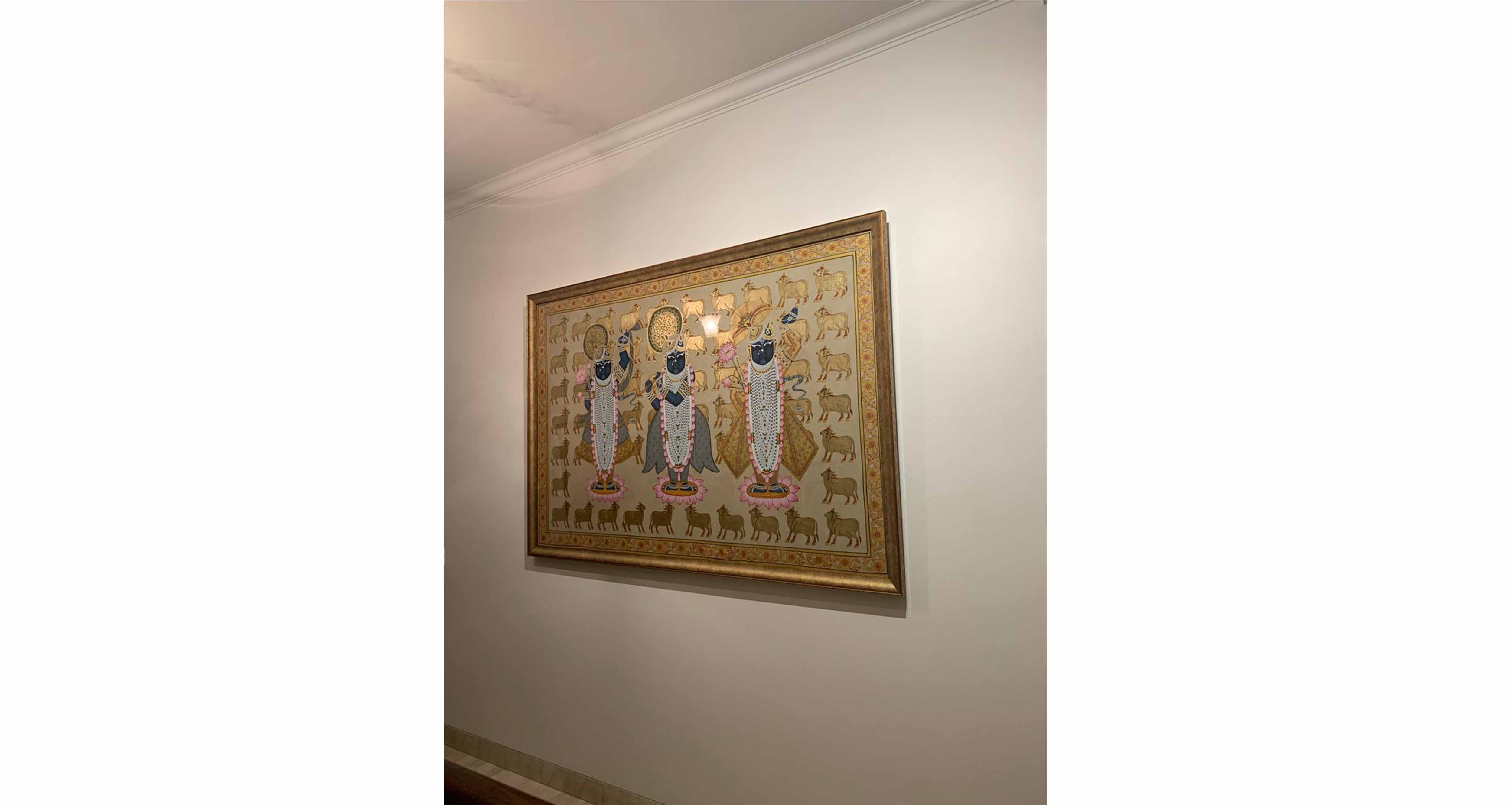
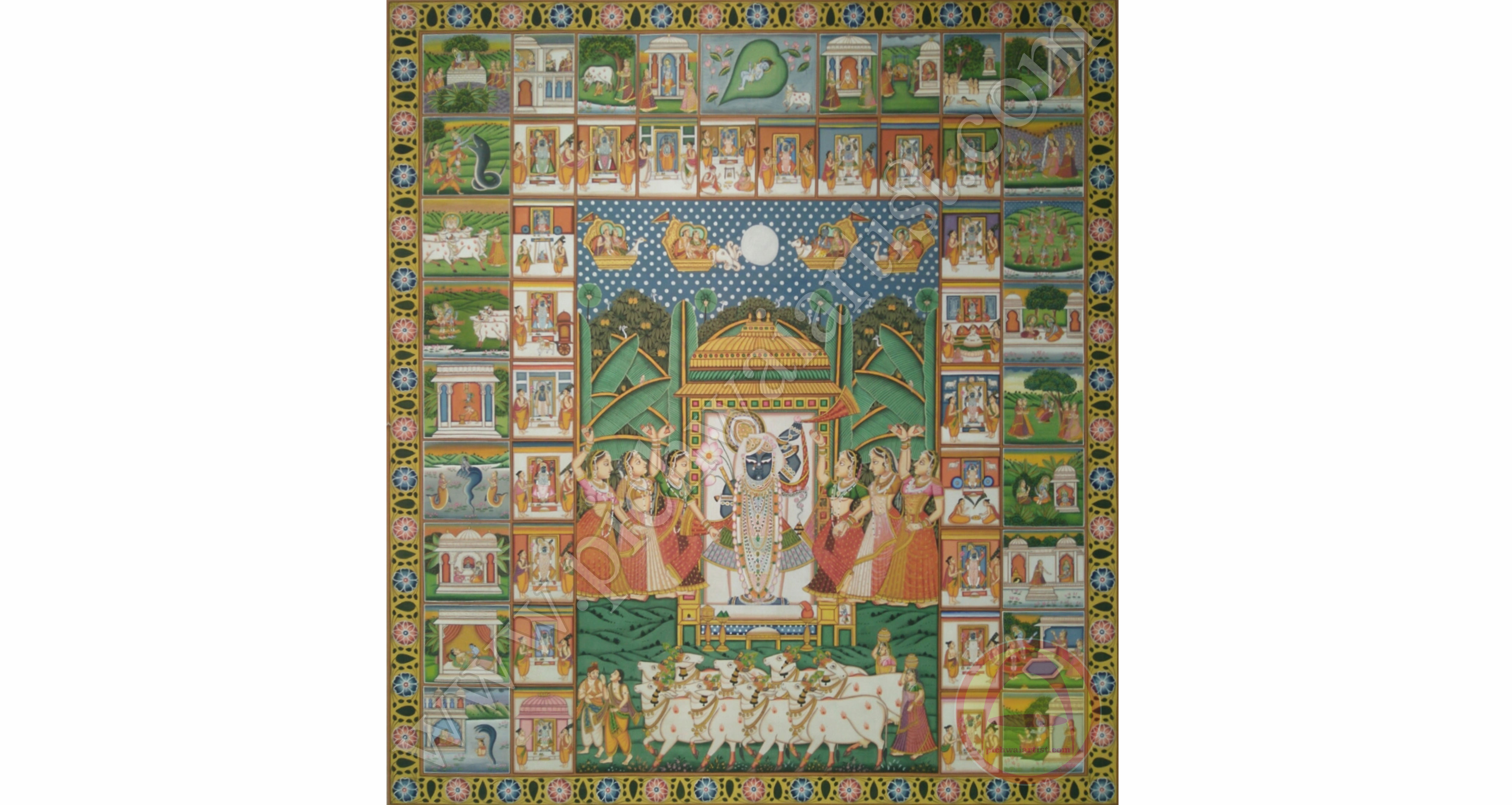
At the heart of many Pichwai traditions stands Shrinathji.
He is not simply a figure placed in the middle of a composition.
He is the reason the world exists around Him.
The raised arm recalls Krishna lifting Govardhan Hill.
The dark form contrasts beautifully with brilliant garments and elaborate surroundings.
Around Him, the Pichwai artist creates a universe of flowers, cows, trees, attendants, ornaments and celestial moods.
The composition therefore has an extraordinary visual principle:
Everything leads the eye toward the divine centre.
This is one of the secrets behind the unmistakable presence of a powerful Pichwai.
The Language of Flowers
Look closely at a Pichwai and you will discover that flowers are never merely decoration.
A flower can create rhythm.
A flower can frame a deity.
A flower can fill empty space.
A flower can suggest abundance.
A flower can transform a plain surface into a living garden.
And the lotus has a particularly important visual presence in Indian devotional art.
Its symmetry, purity and association with sacred imagery make it one of the most beautiful elements available to the Pichwai artist.
But the true magic lies in repetition.
One flower becomes a motif.
Many flowers become a garden.
And a garden becomes an atmosphere.
Cows: More Than Beautiful Animals
Few subjects are more closely associated with the visual world of Krishna than cows.
In Pichwai, cows can appear in astonishing numbers.
Each may have its own posture, expression, decoration or colour pattern.
Some stand quietly.
Some turn their heads.
Some appear to move through the composition.
Calves gather close to their mothers.
The result is not simply a collection of animals.
It is a vision of peaceful abundance.
Historical Pichhwais preserved by The Metropolitan Museum show how cows and calves could dominate festival compositions, particularly those associated with Krishna's identity as a cowherd.
For many viewers, this is one of the first moments when Pichwai begins to feel alive.
The Peacock: A Celebration of Beauty
The peacock is another beloved element of the Pichwai vocabulary.
Its feathers bring colour, movement and elegance.
Its curved neck introduces graceful lines.
Its presence can transform a static composition into something that feels almost musical.
A skilled artist does not simply “draw a peacock.”
The artist considers:
its position,
its direction,
the curve of its body,
the rhythm of its feathers,
its relationship with flowers and foliage,
and its relationship with the central deity.
That is how individual elements become one composition.
The Secret of Pichwai Is in the Details
From a distance, a Pichwai may appear rich and magnificent.
But come closer.
Closer still.
And the painting begins to reveal another universe.
A tiny leaf.
A delicate petal.
The eye of a cow.
The ornament of a figure.
A fine architectural line.
A repeated floral pattern.
A carefully balanced border.
The experience changes with distance.
From far away, you see the whole world.
From close up, you discover the hands of the artist.
This is one of the great pleasures of handmade Pichwai.
From Cloth to Sacred Artwork
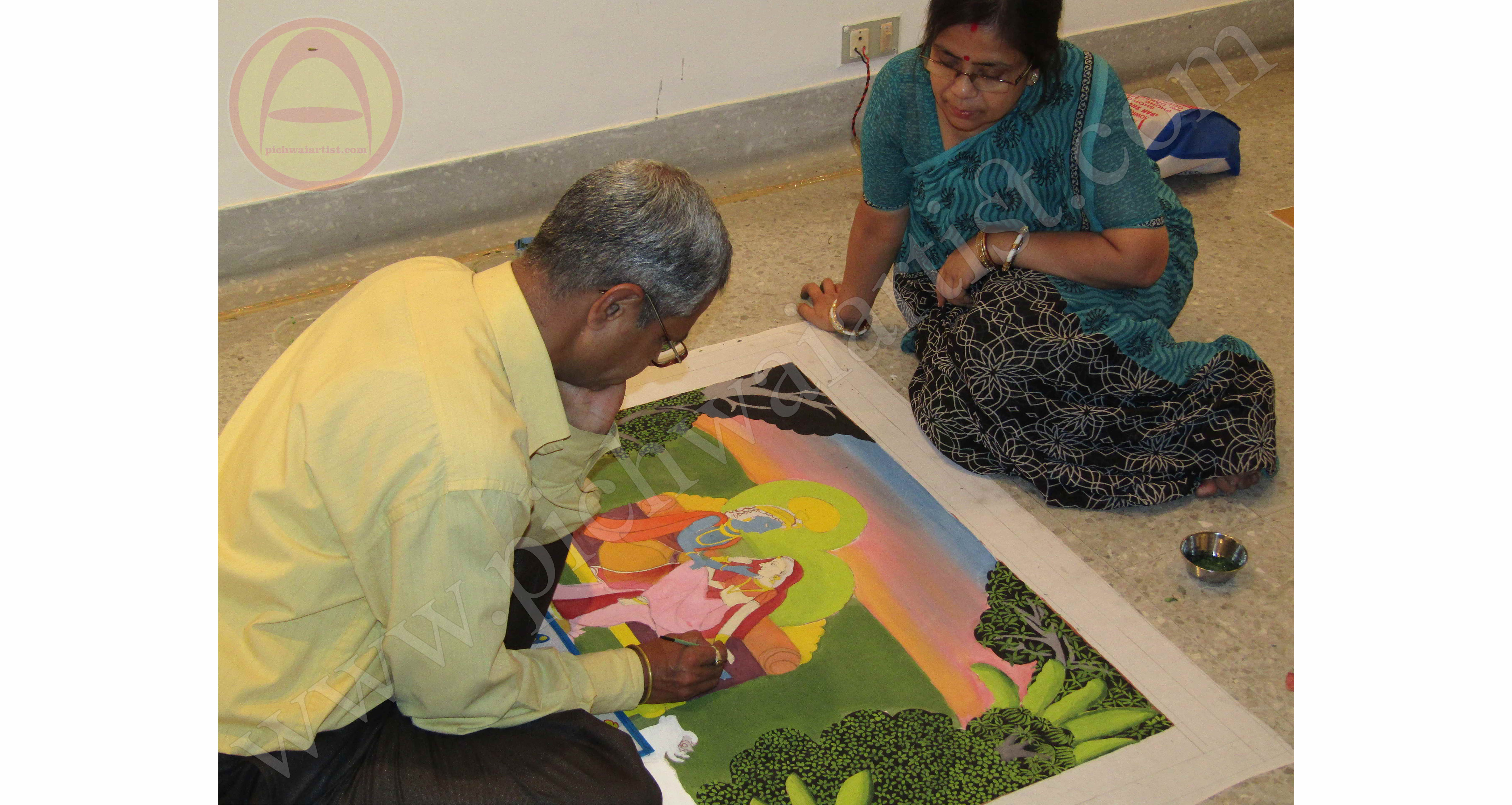
Traditional Pichhwai painting is associated with painted textile surfaces, often prepared and worked carefully before the detailed painting begins.
Historical museum examples demonstrate the diversity of materials and techniques used in Pichhwai traditions, including cotton, painted pigments, dyed textiles and gilding.
The process can be painstaking.
The surface must be prepared.
The composition must be planned.
The major forms must be established.
Colours must be built carefully.
Details must be refined.
Borders must be balanced.
And finally, the painting must become visually harmonious.
The Government of India's tourism material notes that detailed Pichwai works can take anywhere from weeks to months depending on their scale and complexity.
That time is not a weakness.
That time is part of the artwork.
Handmade Pichwai vs. Printed Imitation
In today's world, almost anything can be reproduced instantly.
A photograph can be printed.
A pattern can be copied.
A digital image can be enlarged.
But something important disappears when the human hand disappears.
A handmade Pichwai carries evidence of decisions.
The pressure of a brush.
The rhythm of a line.
The slight individuality of repeated forms.
The patience required to complete thousands of details.
A printed image may reproduce the appearance of a Pichwai.
A handmade painting carries the presence of the person who created it.
This distinction matters enormously for collectors.
When purchasing a Pichwai as an artwork rather than merely as decoration, the buyer should ask:
Who painted it?
Was it actually painted by hand?
What materials were used?
What is the story behind the composition?
How was the artist trained?
What tradition does the work belong to?
These questions do not reduce the beauty of art.
They deepen it.
Why Authenticity Matters
Authenticity is not simply about age.
A newly painted Pichwai can be an authentic work of living tradition.
An old work can be valuable because of its history, provenance and craftsmanship.
A contemporary handmade Pichwai can be important because it demonstrates that the tradition is still alive.
Therefore, the question should not always be:
“Is it old?”
A more meaningful question is:
“Is the artistic tradition alive in this work?”
That is where the future of Pichwai lies.
Not in freezing the tradition in the past.
But in allowing it to continue with integrity.
Pichwai Is a Visual Calendar
One of the most fascinating aspects of the tradition is its relationship with festivals and devotional occasions.
The painting can change the atmosphere of the shrine.
Different imagery can correspond to different moments in the sacred calendar.
This means Pichwai is not merely a collection of subjects.
It is a visual calendar of devotion.
The moon.
The monsoon.
The flowers.
The cows.
The festivals.
The seasons.
The changing garments of Shrinathji.
The changing emotional atmosphere.
All become part of the artistic language.
Sharad Purnima: When the Moon Becomes a Painter
There are few subjects more naturally suited to Pichwai than the full moon of autumn.
The night sky creates a deep visual field.
White flowers become luminous.
Silver and pale tones appear almost celestial.
Figures and trees seem to exist between earth and heaven.
Historical Nathdwara material in The Metropolitan Museum includes a nineteenth-century diagram for a Pichwai depicting Sharad Purnima, demonstrating the specificity with which such festival compositions were planned.
This is one of the reasons Pichwai can feel almost cinematic.
It does not merely tell you that it is night.
It makes you feel the night.
Gold Is Not Merely Decoration
Gold has a special ability to change the experience of a painting.
Under soft light, it may appear quiet.
Under direct light, it can suddenly awaken.
A golden ornament can sparkle.
A border can begin to glow.
A divine figure can appear surrounded by light.
Historical Pichhwais are known to incorporate gold and, in some traditions, silver extensively.
The result is something difficult to capture in a photograph.
A Pichwai is often best experienced in changing light.
Why Pichwai Feels So Joyful
Perhaps the greatest secret of Pichwai is its emotional quality.
It is devotional, but it is not necessarily gloomy.
It celebrates.
It welcomes.
It blooms.
It surrounds the viewer with flowers, animals, colour, music, festivals and divine beauty.
There is movement everywhere.
There is life everywhere.
Even when the central deity is still, the world around Him appears to breathe.
That is why a beautiful Pichwai can create an unusual feeling:
peace and celebration at the same time.
A World of Stories Without Words
A remarkable Pichwai can communicate without explaining itself.
A viewer may not know the complete theology.
They may not know the festival.
They may not know every symbolic meaning.
Yet they can still feel something.
They can see abundance.
They can feel beauty.
They can sense devotion.
They can discover rhythm.
They can experience wonder.
This makes Pichwai especially powerful for an international audience.
You do not need to be born in Rajasthan to appreciate a moonlit garden.
You do not need to speak Hindi to admire a beautifully painted cow.
You do not need to know every story of Krishna to feel the warmth of colour and composition.
Beauty can cross languages.
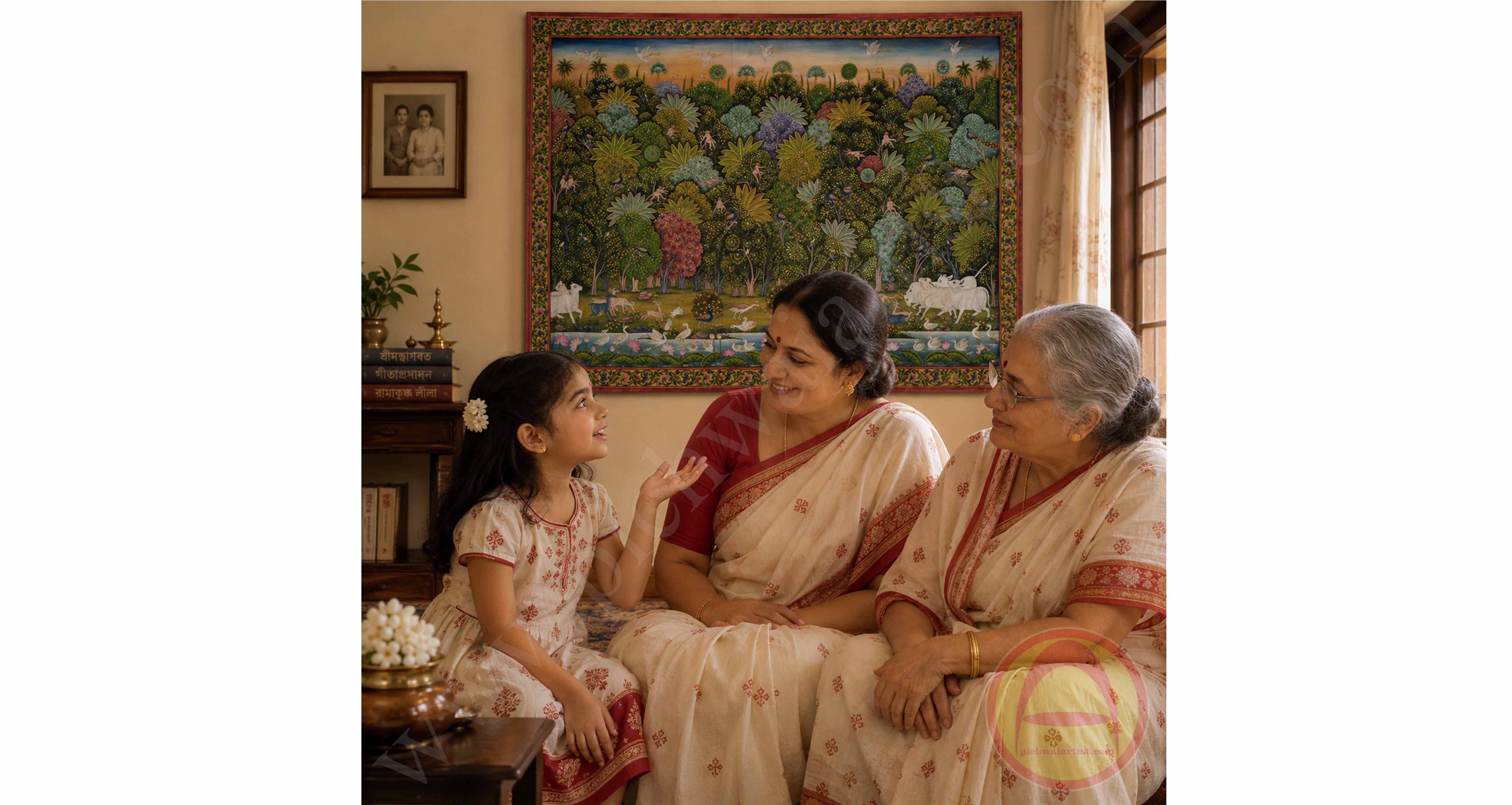
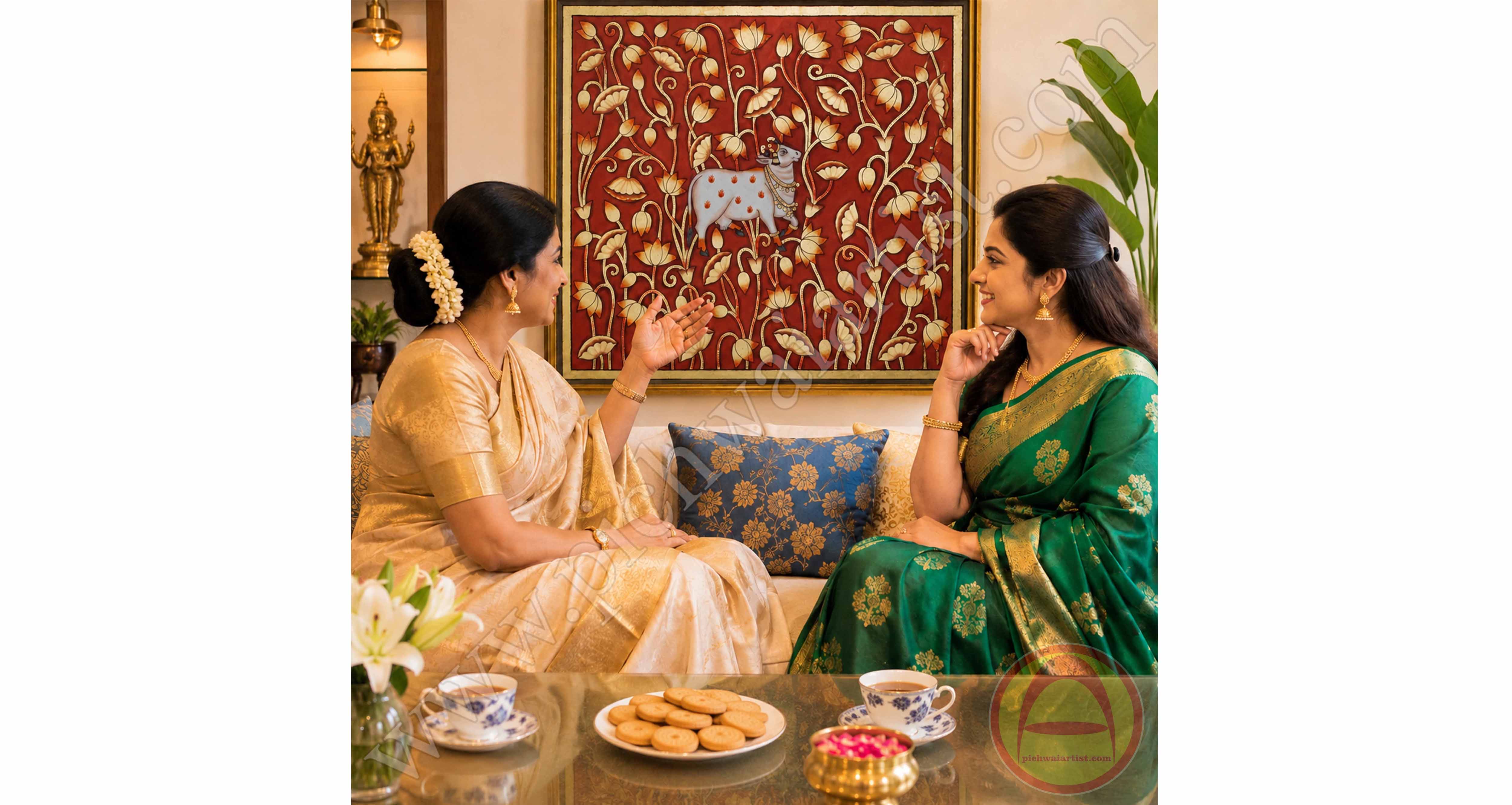
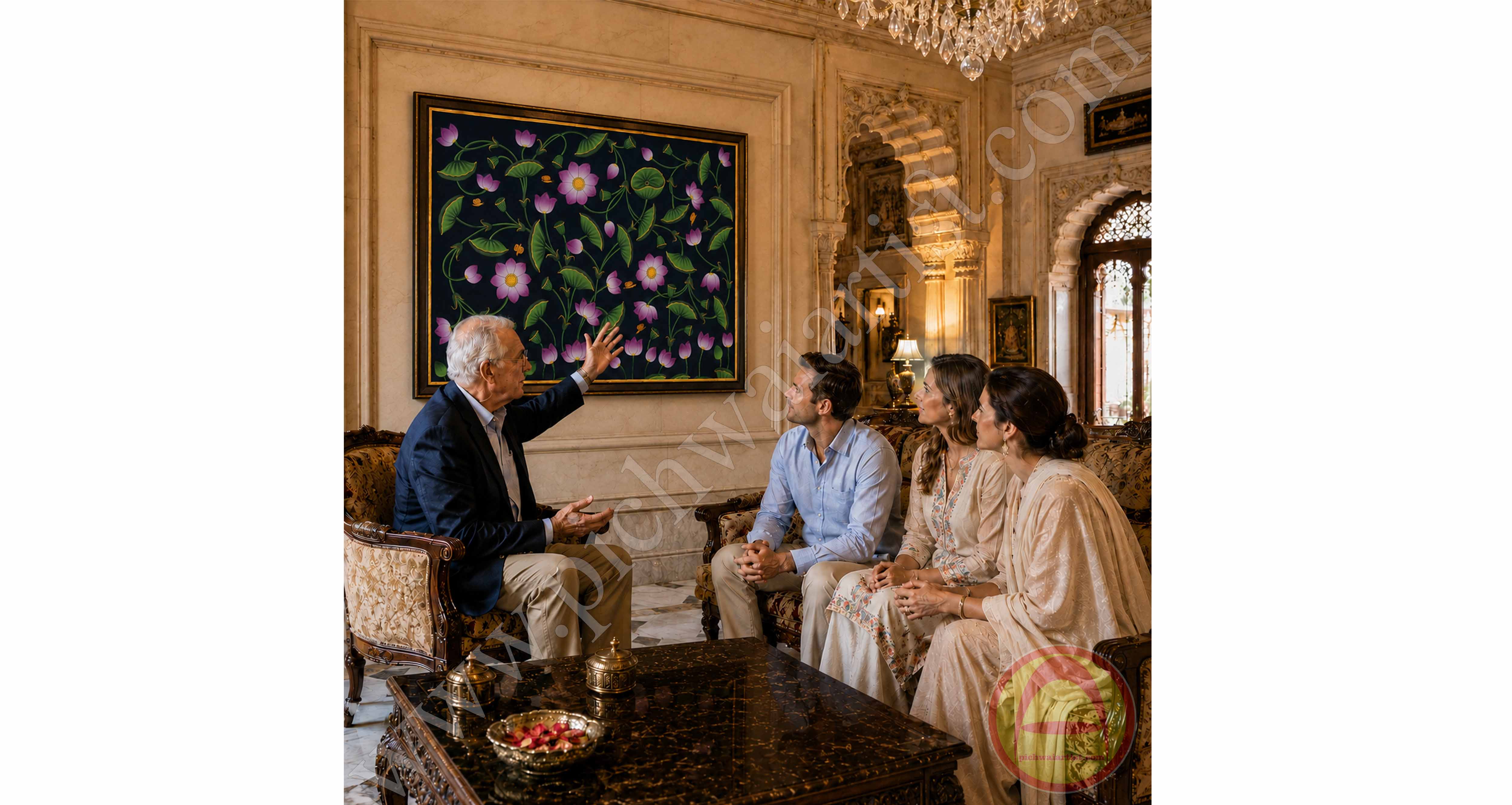
Pichwai and the Modern Home
Today, Pichwai has travelled far beyond the shrine.
It can be found in private collections, heritage interiors, galleries and contemporary homes around the world.
But its transformation into a decorative artwork creates an important responsibility.
When a Pichwai enters a modern home, its story should not disappear.
The collector should know:
Where did this tradition come from?
Why were these paintings created?
What does the imagery mean?
Who made the painting?
What makes this particular work special?
When the story travels with the painting, the artwork becomes more than an interior object.
It becomes a cultural ambassador.
Pichwai in Museums and Collections Around the World
Pichwai is not confined to Rajasthan.
Historic examples are held in major international museum collections.
The Metropolitan Museum of Art, for example, preserves Pichhwai works from Rajasthan and other regions, including nineteenth-century examples and earlier festival textiles.
Their presence in major collections tells us something important.
Pichwai is not merely a local decorative craft.
It belongs to the broader history of Indian art, devotional painting and painted textiles.
It deserves to be studied, preserved, collected and experienced alongside other great artistic traditions of the world.
The Artist: The Invisible Presence Behind the Painting
When we look at a finished Pichwai, it is easy to forget the artist.
We see Krishna.
We see cows.
We see flowers.
We see gold.
But behind every line is a human hand.
Behind every repeated flower is patience.
Behind every carefully balanced composition are countless decisions.
Behind every finished painting are hours that cannot be recovered.
The artist gives something to the painting that a machine cannot give:
time.
And perhaps that is why handmade art feels different.
The viewer may not consciously see the hours.
But somehow, the viewer feels them.
Pichwai Is a Living Tradition
Tradition is sometimes misunderstood as something that must never change.
But a living tradition does not remain alive by refusing to breathe.
It remains alive because each generation learns from the past and creates something meaningful for its own time.
The essential spirit of Pichwai can remain intact while artists explore new compositions, scales, colour relationships, materials and ways of presenting the art.
The goal should not be to make Pichwai modern merely for the sake of being modern.
Nor should the goal be to imitate the past mechanically.
The goal is something more difficult:
to carry the soul forward.
What Makes a Pichwai Truly Beautiful?
Is it the number of flowers?
The amount of gold?
The size?
The complexity?
The colours?
The subject?
Not necessarily.
A truly beautiful Pichwai has something deeper:
Harmony.
The deity and the surrounding world must belong together.
The colours must speak to one another.
The details must enrich rather than overwhelm.
The empty spaces must breathe.
The border must support the composition.
Every element must know its place.
When all of these things happen together, the painting stops feeling assembled.
It begins to feel inevitable.
As though the world could not have been painted any other way.
How to Look at a Pichwai
The next time you stand before a Pichwai, do not look at it only as a picture.
Take three steps.
First, stand far away.
See the whole composition.
Where does your eye go first?
How does the painting create balance?
Does it feel calm, festive, dramatic or peaceful?
Then move closer.
Look at the flowers.
Look at the animals.
Look at the figures.
Look at the borders.
Look at the tiny details.
Finally, look even closer.
Find the artist.
Look for the brushwork.
Look for the rhythm of the lines.
Look for the tiny differences that reveal the human hand.
And then step back again.
You may discover that the painting has changed.
It has not changed at all.
You have.
A Message to the Global Art Lover
If you are seeing Pichwai for the first time, do not worry about knowing everything.
You do not need to.
Begin with wonder.
Look at the colours.
Follow the flowers.
Watch the cows.
Find the peacocks.
Look at Shrinathji.
Notice the moon.
Allow the details to slowly reveal themselves.
Then, when curiosity arrives, learn the stories.
Because Pichwai rewards both the eye and the heart.
A Message to Collectors
If you are considering purchasing a Pichwai, do not buy only because a painting looks beautiful.
Ask about its story.
Ask about its artist.
Ask whether it is handmade.
Ask about its materials.
Ask how long it took to create.
Ask what the composition represents.
Ask whether the work is an original painting or a reproduction.
And most importantly:
Ask whether the person selling it respects the tradition.
A collector does not merely purchase an object.
A collector becomes part of the object's journey.
A Message to Museums and Galleries
Pichwai deserves to be approached not merely as decorative textile art, but as a multidimensional artistic tradition.
It connects:
devotion and painting,
textile and architecture,
festival and visual culture,
nature and mythology,
craftsmanship and spirituality,
tradition and contemporary artistic practice.
Its richness offers opportunities for exhibitions, scholarship, conservation, education and cross-cultural dialogue.
For museums and galleries, Pichwai provides a remarkable opportunity to introduce audiences to a living Indian tradition whose visual vocabulary is both deeply rooted and extraordinarily accessible.
The Future of Pichwai
The future of Pichwai will not be decided only by artists.
It will also be shaped by collectors.
By museums.
By galleries.
By scholars.
By families.
By young people.
And by people around the world who encounter a Pichwai and decide that this beautiful tradition deserves to continue.
Every authentic handmade Pichwai that finds a thoughtful home becomes part of that future.
Every young artist who learns the discipline of the tradition extends its story.
Every museum that preserves an important work protects a piece of cultural memory.
Every person who learns the meaning behind the painting helps the tradition travel farther.
From Nathdwara to the World
Perhaps this is the most beautiful journey of all.
A tradition born in a sacred landscape of Rajasthan can now be experienced by someone thousands of kilometres away.
A painting created by hand can cross oceans.
A story from Nathdwara can enter a home in London, New York, Paris, Tokyo, Sydney or anywhere else in the world.
And yet, if the painting is created with sincerity, something remains unchanged.
The flowers still bloom.
The cows still gather.
The peacocks still dance.
The moon still rises.
And Shrinathji still stands at the heart of the composition.
That is the extraordinary power of Pichwai.
Pichwai Is Not Just a Painting
Perhaps we should stop calling Pichwai simply a “painting.”
Because a Pichwai can be:
A story.
A prayer.
A celebration.
A calendar.
A landscape.
A memory.
A piece of craftsmanship.
A cultural inheritance.
A window into Rajasthan.
A bridge between generations.
And, for many devotees, a way of creating an environment for darshan.
The painted cloth may be silent.
But it speaks.
It speaks through colour.
It speaks through flowers.
It speaks through Krishna.
It speaks through the hands of the artist.
And it speaks across centuries.
The Living Soul of Pichwai
Pichwai has travelled a remarkable distance.
From sacred spaces to museums.
From Nathdwara to international collections.
From temple traditions to contemporary homes.
From the hands of traditional artists to the eyes of a global audience.
But its greatest journey may still lie ahead.
Because the future of Pichwai is not simply about preserving old paintings.
It is about ensuring that the spirit of handmade Pichwai continues to live.
As long as an artist sits before a prepared cloth and begins the first line…
As long as flowers continue to be painted one by one…
As long as someone pauses before a Pichwai and feels something they cannot quite explain…
Pichwai is alive.
And perhaps that is the greatest beauty of all.
It does not ask us merely to look at it.
It invites us to enter its world.
Welcome to Pichwai.
Welcome to Nathdwara.
Welcome to a world where art becomes darshan.
About Pichwai Painting Artist
At Pichwai Painting Artist, our purpose is to share the beauty, depth and living tradition of authentic handmade Pichwai with art lovers, collectors and admirers around the world.
We believe that a Pichwai should not be experienced merely as an attractive wall painting.
It should be understood.
Its story should be known.
Its craftsmanship should be respected.
And the artist's hand should remain visible in the soul of the work.
For us, preserving Pichwai does not mean keeping it locked in the past.
It means allowing this extraordinary tradition to continue speaking to the world — with respect for its roots and with the creative spirit of the present.
Pichwai is an ancient tradition.
But its beauty belongs to everyone who is willing to see it. Thank you 🌴🌴
Created by-
Arun Sharma
Pichwai Painting Artist
Contact- +91 72969 760088 (WhatsApp)