


Pichwai Was Never Meant to Be Just a Product The Difference Between Decorative Art and Devotional Presence
Across generations, Pichwai was created not merely to decorate walls, but to bring devotion, peace, grace, and sacred beauty into a home. In today’s world, where many artworks are produced only for commercial demand, collectors often wonder: does the spirit of a painting matter? This article explores why traditional Pichwai has always been more than a luxury object — and why the intention behind sacred art still holds meaning for collectors around the world.
There was a time when Pichwai paintings were not viewed as “products” at all.
They were created as offerings of devotion.
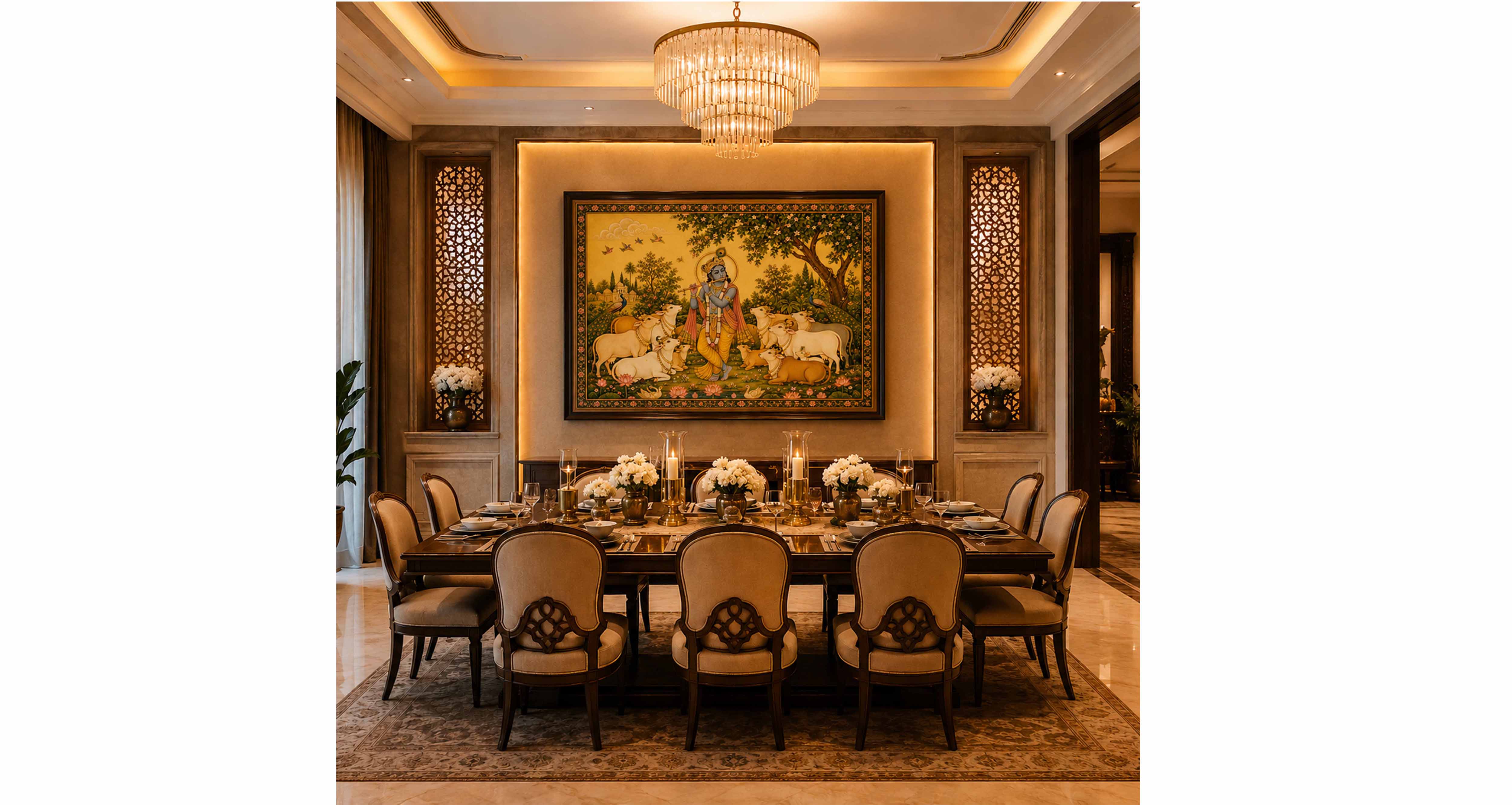
In the temples of Nathdwara and in traditional Indian homes, Pichwai was painted to honor the divine presence of Shrinathji. The paintings were not made merely to fill empty walls or match interiors. They carried a purpose far deeper — to create an atmosphere of serenity, reverence, beauty, and spiritual abundance within a space.
For generations, families believed that the presence of devotional art influenced the emotional and spiritual character of a home. A carefully painted Pichwai was seen not only as an artwork, but as a source of calmness, auspiciousness, and cultural grace.
Even today, many collectors around the world describe a similar feeling when they live with authentic handmade Pichwai art.
Some speak about a sense of peace.
Some feel emotionally connected to the painting.
Others simply feel that the space becomes warmer, more alive, and spiritually comforting.
This connection is difficult to explain through technique or design alone.
Because true Pichwai has never been only about color and ornamentation.
Its essence lies in the feeling with which it is created.
Today, the growing popularity of Pichwai has also transformed it into a commercial industry. Paintings are often produced rapidly to satisfy market demand, interior trends, and decorative consumption. There is nothing wrong with artists earning through their work — art has always supported livelihoods, families, and traditions.
But collectors often sense an important difference between art that is created only for sale and art that is created with patience, reverence, and emotional involvement.
A traditional devotional painting carries the visible marks of human attention.
The brushwork feels alive.
The imperfections feel honest.
The details reveal time, care, and discipline.
Most importantly, the painting carries intention.
In Indian artistic traditions, intention has always mattered. Whether in temple sculpture, miniature painting, classical music, or sacred architecture, the inner state of the creator was believed to influence the final work. Sacred art was never separated from sincerity.
This is one reason why handmade Pichwai continues to resonate deeply with collectors, even in modern luxury spaces across the world.
Collectors today are increasingly searching for art that possesses meaning, presence, and authenticity. In an age of mass production and digital imitation, people long for objects that still carry a human spirit within them.
A genuine Pichwai does not compete for attention through excess.
Its power is quieter.
It transforms a room gradually.
It changes the emotional atmosphere of a home.
It invites stillness into busy spaces.
For many Indian families, placing devotional Pichwai in a home remains connected with ideas of harmony, prosperity, blessings, and cultural continuity. For international collectors, the attraction often comes from another direction — the desire to live with art that feels soulful rather than manufactured.
And perhaps this is why traditional Pichwai continues to survive across centuries.
Not because it follows trends.
But because it carries feeling.
A sacred painting cannot be measured only by size, detail, or market price. Its deeper value often lies in what it quietly brings into a space — peace, reflection, emotional warmth, and a sense of timelessness.
The most meaningful Pichwai paintings are rarely those created in haste.
They are the ones made with devotion.
With patience.
With respect for tradition.
And with the understanding that sacred art was never meant to be merely consumed.
Because in the end, a true Pichwai does more than decorate a wall.
It becomes part of the atmosphere of a home. Thank You 🌺🌺
Arun Sharma
Pichwai Painting Artist
Contact- +91 72969 76088